
The Fastest Network on Earth: How F1 Teams Transmit Data at 200mph
February 12, 2026
When the Race is in the Data, Not Just the Asphalt
Picture this: it’s Lap 47 of the Monaco Grand Prix. Lando Norris is pushing his McLaren through the narrow streets of Monte Carlo, tires millimeters from the barrier, apex speeds touching 180 mph. At the same moment, in the McLaren garage, a race engineer is staring at a screen watching 1.1 million data points per second flow from that car in real-time.
Every twitch of the steering wheel. Every degree of brake temperature. Every pressure fluctuation in the hydraulics. All of it racing through the air at nearly the speed of light, while the car itself screams around one of the world’s most unforgiving circuits.
This isn’t magic. It’s one of the most challenging telecommunications engineering problems on the planet.
And today, I want to take you on a journey through the invisible race happening parallel to every Grand Prix — the race to move data faster than the cars themselves.
The Scale of the Problem: A Data Center on Wheels
Let’s put things in perspective.
A modern F1 car is essentially a distributed computing platform wrapped in carbon fiber. Each vehicle carries approximately 300 sensors, monitoring everything from tire pressure and brake temperature to G-forces, suspension travel, and aerodynamic load.
During a single race weekend, one car generates around 1.5 terabytes of data.
To put that in relatable terms: that’s roughly equivalent to streaming 750 hours of high-definition video. Or about 500,000 photos. Or the entire uncompressed text of Wikipedia — 300 times over.
But here’s the kicker: unlike your Netflix stream, which can buffer and resume, this data has to flow continuously, reliably, and instantaneously from a vehicle accelerating, braking, and cornering at violent speeds. And unlike a mobile phone in a car, which might experience brief interruptions without consequence, every packet matters.
When a race engineer needs to know if that slight vibration is a tire starting to delaminate or just a curb strike, they can’t afford to wait for a retry. The decision to pit — or not to pit — might be worth millions of dollars and a championship.
The Anatomy of a Telemetry Link
To understand how this works, let’s break down what a Formula 1 telemetry system actually looks like.
On the Car: The Nervous System
At the heart of each F1 car sits the Standard ECU (Electronic Control Unit), supplied by McLaren Applied Technologies. Think of it as the car’s brain — a hardened computer designed to survive extreme heat, vibration, and G-forces while processing inputs from those 300+ sensors scattered across the chassis.
These sensors include:
Accelerometers and gyroscopes measuring forces in every direction
Pressure sensors in the hydraulics, fuel system, and tires
Temperature probes embedded in brakes, engine, and gearbox
Position sensors tracking suspension movement and steering angle
Flow meters monitoring fuel consumption and oil circulation
The ECU samples these inputs thousands of times per second, compressing and packaging them into telemetry packets. But now comes the hard part: getting that data off the car.
The Telemetry Data Flow
Here’s how data travels from the car to the engineers:

The Radio Link: Physics at 200mph
Here’s where telecommunications engineering enters the chat.
F1 telemetry operates in licensed radio frequency bands, typically around 1.5 GHz for the primary telemetry link and 2.4 GHz or 5 GHz for high-bandwidth applications. The cars transmit to receiver towers positioned around the circuit, which then relay data to the pit wall and ultimately to the team’s factory thousands of miles away.
But this isn’t like connecting to Wi-Fi in your living room. Let’s talk about why.
The RF Challenges: When Physics Fights Back
Operating a wireless data link from a moving vehicle at race speeds introduces challenges that would make a typical telecom engineer break out in a cold sweat. Let’s walk through the big three.
1. The Doppler Effect: Frequency on the Move
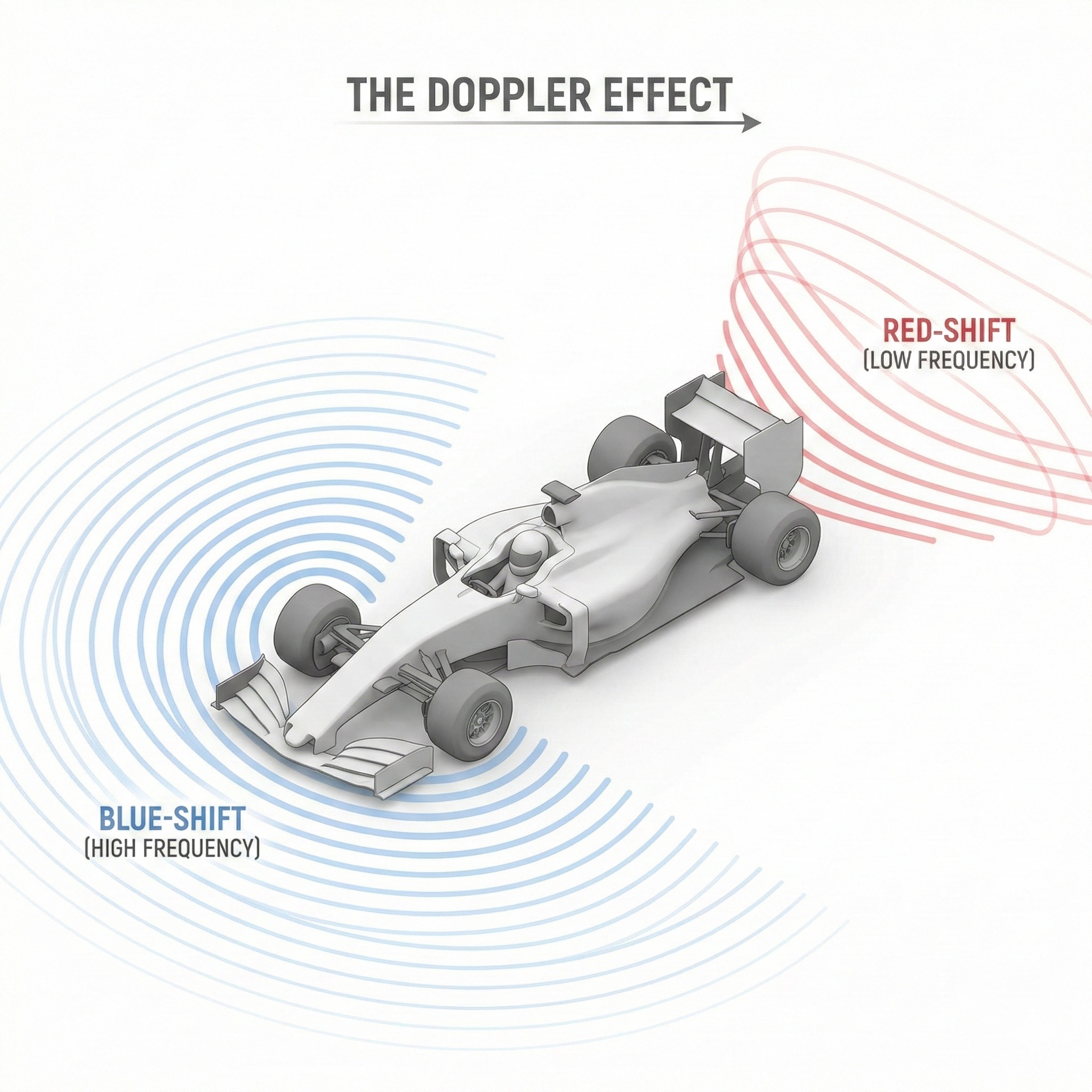
You know that sound when an ambulance passes by — the pitch dropping as it moves away? That’s the Doppler effect, and it applies to radio waves just as it does to sound.
When an F1 car approaches a receiver tower at 200 mph (about 89 meters per second), the frequency of its radio transmission appears shifted upward. When it recedes, the frequency shifts downward. At 1.5 GHz, that shift is approximately 440 Hz — small, but significant enough to matter for narrow receiver filters.
Modern telemetry systems compensate for this by using wider frequency channels and adaptive receivers that can track the shifting signal. But it’s a constant battle against the fundamental physics of motion.
2. Multipath Fading: The Ghost in the Machine
Now imagine you’re at Monaco. The cars are threading between casinos, hotels, and apartment buildings — concrete and steel canyons that reflect radio signals in every direction.
When a transmitter and receiver have multiple paths between them (direct line-of-sight plus reflections off buildings), the signals can arrive at slightly different times. Depending on phase relationships, these signals can constructively interfere (boosting the signal) or destructively interfere (cancelling it out entirely).
This is called multipath fading, and in a street circuit environment, it can cause signal strength to fluctuate wildly from moment to moment.
Engineers combat this using:
Diversity antennas on the cars (multiple antennas positioned at different angles)
Error correction codes that can reconstruct lost data
Frequency hopping to avoid consistently bad channels
Strategic receiver placement around the circuit

3. The Handoff Problem: Passing the Baton at Speed
As cars circulate, they move between coverage areas of different receiver towers. Just like your phone hands off between cell towers on a highway, F1 telemetry must seamlessly transition from one base station to another.
But at 200 mph, that handoff needs to happen fast. A car travels nearly 90 meters per second — the length of a football field every 1.1 seconds. There’s no time for lengthy negotiation protocols.
The system uses predictive algorithms that anticipate which receiver will have the best signal based on car position, speed, and circuit geometry. It’s a delicate dance of timing and engineering.

Beyond the Pit Wall: The Real-Time Factory
Here’s where things get truly remarkable.
That 1.1 million data points per second? It doesn’t just sit in the garage. Within milliseconds, it’s flowing through fiber optic cables to team factories — often thousands of miles away — where hundreds of engineers analyze it in real-time.
During a race, a team like Mercedes or Red Bull might have:
Strategists running Monte Carlo simulations on when to pit
Power unit engineers monitoring engine health and thermal loads
Aerodynamicists studying real-world airflow data
Tire specialists predicting degradation curves
All of them watching the same race, through the lens of data moving at the speed of light from a car doing 200 mph around a circuit.
The latency? Under 100 milliseconds from sensor to screen. That’s faster than the blink of an eye.
The AWS Layer: Making Sense of the Noise
Since 2018, Formula 1 has partnered with Amazon Web Services to bring this data to fans in the form of on-screen graphics and insights. But behind those slick “F1 Insights” graphics is some serious engineering.
AWS systems process that telemetry stream alongside 70 years of historical race data, using machine learning to:
Predict pit stop windows and optimal strategies
Identify when drivers are pushing too hard (or not hard enough)
Detect emerging mechanical issues before they become catastrophic
Calculate championship probabilities in real-time
The result is what amounts to a real-time digital twin of each race — a complete simulation running parallel to reality, powered by the marriage of high-speed telemetry and cloud computing.

Why This Matters: Engineering at the Limit
So why am I — a telecommunications student and F1 fanatic — so fascinated by all of this?
Because F1 telemetry represents telecommunications engineering in its purest, most demanding form. Every challenge you study in textbooks — Doppler shift, multipath fading, link budgets, error correction — comes alive here, amplified by the most extreme conditions imaginable.
When we talk about 5G and the future of wireless communication, we’re really talking about solving problems that F1 engineers have been wrestling with for decades. The ability to maintain reliable, high-bandwidth connections with moving vehicles? That’s relevant to autonomous cars. The algorithms for seamless handoffs between base stations? That’s the future of mobile networks.
F1 is often called the “pinnacle of motorsport.” But it’s also a proving ground for communications technology — a place where theory meets reality at 200 miles per hour.
The Next Lap: Where Do We Go From Here?
As we look to the future, several trends are emerging:
Higher bandwidth: Next-generation telemetry systems are pushing into 10 Gbps territory, enabling real-time video transmission from onboard cameras and even richer sensor arrays.
Edge computing: Rather than sending all data back to the factory, teams are deploying edge computing nodes at the circuit, allowing faster local processing for critical decisions.
AI on the car: Future ECUs may incorporate machine learning accelerators, allowing cars to make autonomous decisions about power management, differential settings, or even suspension adjustments without waiting for human input.
Fan connectivity: The same infrastructure that serves teams is increasingly being opened to fans, offering real-time data streams and immersive experiences that put you in the cockpit from your living room.
Closing the Loop
The next time you watch a Grand Prix, remember: there’s a second race happening in the invisible spectrum all around the circuit.
While the drivers battle for tenths of a second on the track, thousands of engineers are racing to move data even faster — extracting insight from chaos, signal from noise, meaning from the blur of a car at maximum attack.
In Formula 1, victory is measured in milliseconds. And increasingly, those milliseconds are won not just on the asphalt, but in the invisible network that binds car to team, driver to engineer, and instinct to intelligence.
That’s the fastest network on Earth. And it’s only getting faster.
Want to explore more intersections of telecommunications and motorsport?
Reach out to me — I’d love to hear your questions about RF engineering, telemetry protocols, or anything else F1-tech related!
Further Reading & Resources:
AWS for Sports: Formula 1 — How AWS powers F1 data analytics
McLaren Applied Technologies — The standard ECU supplier for Formula 1
FIA Technical Regulations — The rulebook governing telemetry systems
If you enjoyed this blog, consider sharing it with fellow F1 or engineering enthusiasts. Let’s spread the love for the tech that makes the racing possible!